
What Actually Drives Rate Spikes in Munich, Frankfurt, Milan, Berlin and Bilbao
Hotel prices during trade fairs can rise by 2 to 5 times their normal rate: a Munich room that costs around €190 on an ordinary night hit €453 during the Bauma machinery fair, and a Frankfurt room that runs about €85 normally has reached €430 during Automechanika. But the number that matters more than either of those is this: the surge is never citywide. It hits specific streets, specific hotels, sometimes specific nights, while the rest of the same city, often just a few minutes’ walk away, trades at a completely ordinary rate the same week.
That’s the argument this whole guide makes: knowing that fairs make hotels expensive is close to useless. Knowing exactly where the expensive part lives is what actually saves money. Everything below either shows that pattern in the data, or shows what to do once you know it’s there.
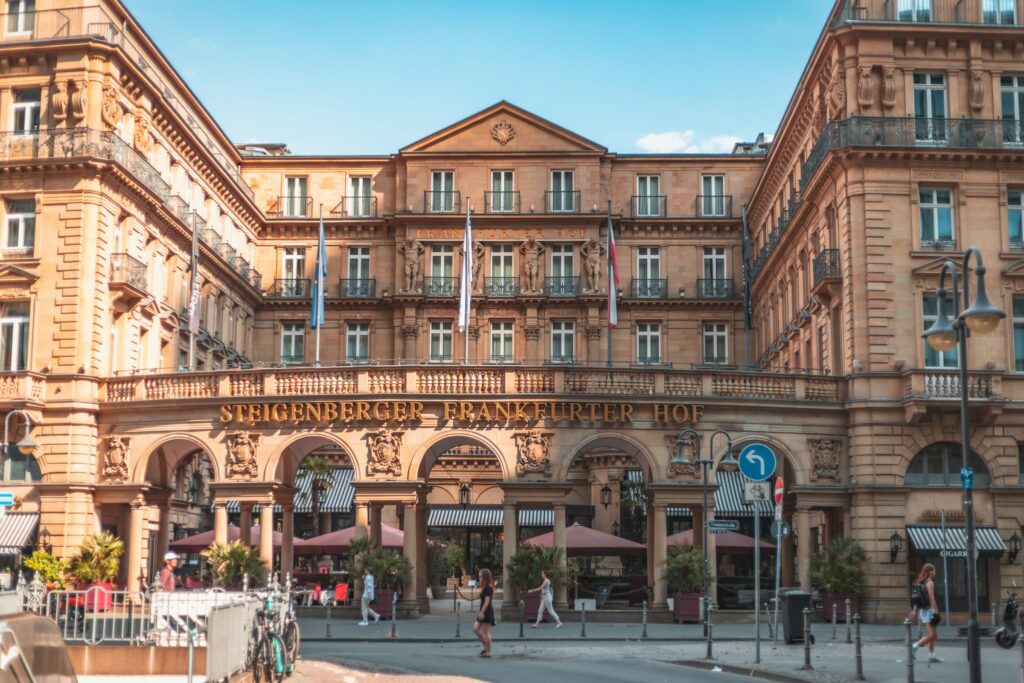
How big is the hotel price surge during major European trade fairs?
Start with the headline numbers, because they’re real and worth taking seriously before getting into the nuance.
| City | Trade fair | Normal ADR | Peak ADR | Multiple |
|---|---|---|---|---|
| Munich | Bauma (machinery, triennial) | ~€190/night avg | €453.21 (peak night) | ~2.4x |
| Munich | Expo Real (real estate, annual) | ~€120–160 | €317.24 | ~2x–2.6x |
| Frankfurt | Automechanika (automotive) | ~€85 | ~€430 | ~5x |
| Milan | Fashion Week | ~€130–170 | €249.60–€414 | ~2x–3x |
| Milan | Winter Olympics opening night | ~€150–200 | €552 | ~3x |
That’s the part every headline gets right. What most coverage misses is that this multiple isn’t a property of the city; it’s a property of a specific hotel, on a specific night, at a specific distance from the fair gates. Three examples make that concrete.
The surge is patchy, not citywide, three examples
Across cities: why Berlin barely moves while Munich spikes 2.4x
Berlin’s ITB fair pushes citywide ADR up only about 5%, to €146.86 (RateGain/Adara), nowhere near Munich’s 2.4x. That’s not because ITB is a smaller fair. It’s because Berlin has a bigger, more elastic hotel market underneath it, one of the reasons Berlin has become such a strong base for large-scale product launches and conferences in the first place.
Munich has no new hotel openings scheduled for 2026 at all, and the lowest competitive intensity of Germany’s major markets (Christie & Co): a small, fixed room supply meeting fair-week demand has nowhere to absorb the pressure. Berlin, by contrast, has a roughly 3,600-room pipeline and the highest competitive intensity of the two: more supply cushions the same demand spike. City size and hotel supply predict surge severity better than the fair itself does. It’s a dynamic worth understanding before sourcing venues and dates for a 2026 event in Germany.
Within a city: a Frankfurt hotel that only doubles, three streets from one that jumps 5x
The same unevenness shows up inside a single city, not just between cities. The Motel One next to Frankfurt’s Messe runs around €79 on an ordinary February Tuesday, and around €189 during the Buchmesse book fair, a little over double, at one named property (hotelguide-frankfurt.com). That’s a far smaller jump than the citywide ~5x figure for Automechanika, because Buchmesse is a smaller fair and this particular hotel sits inside the walking-distance perimeter that absorbs the spike hardest. It’s the same block-by-block logic that shapes ground transport planning around Germany’s biggest trade shows: proximity to the halls changes everything.
Amex GBT’s own coverage of the 2026 World Cup found the identical pattern at a much larger scale: a “patchwork landscape” of sharp spikes around specific match days, venues and base-camp hotels, while other neighbourhoods and dates in the same host cities traded at ordinary seasonal rates. Same mechanism, different event entirely, which suggests this isn’t a trade-fair quirk: it’s how event-driven demand behaves everywhere.
Sometimes it isn’t about price at all: Bilbao
Bilbao doesn’t have a documented per-night rate multiple to match Munich or Frankfurt, and that’s worth saying plainly rather than forcing a number that doesn’t exist. What it has instead is an occupancy problem: citywide hotel occupancy sat at 62.1% for 2025, but events like BIEMH (the biennial machine-tool fair) push it past 90% (Bilbao Ekintza / Eustat). For a compact market with roughly 10,400 hotel beds, the constraint at that level isn’t paying triple: it’s finding a room at all. It’s one of several reasons Bilbao has quietly become a favourite for corporate events, and one worth weighing against nearby San Sebastián if dates are flexible.
Three cities, three different versions of the same underlying pattern: the surge is never smooth, and it doesn’t always even show up as a price. That has a direct, practical consequence for anyone booking a conference that isn’t itself a trade fair.
This catches conference organisers too, even when their event isn’t the trade fair
“Trade fair” and “conference” aren’t the same thing, and the distinction matters more than most planners assume, the two run on genuinely different logistics, budgets and timelines. Bauma and Automechanika are exhibitions: exhibitor stands, a defined show floor, dates set by the fair organiser years ahead. A corporate conference is usually a different format entirely, with no exhibition element and dates the organiser sets independently.
The patchy pricing described above doesn’t care about that distinction. If an independent conference happens to fall in Munich the same week as Bauma, its delegates pay Bauma’s hotel rates, in whichever pocket of the city they happen to book, even though their event has nothing to do with the fair. The trade fair sets the price for that week; every other event sharing the calendar simply inherits whichever piece of the patchwork its hotel sits in.
A trade-fair calendar check takes minutes and costs nothing, and it’s exactly the kind of groundwork experienced event sourcing in Germany builds in from day one. It’s the single most avoidable cost in this whole article, but only if it happens before someone confirms a conference date, not after the hotel quotes come back higher than expected.
Why this isn’t price gouging
The word “gouging” has real news weight behind it right now. In 2026, South Korea’s government moved to introduce stricter penalties for lodging price gouging after hotels near BTS concerts in Busan reportedly raised rates by as much as several dozen times their normal level, and the UK saw similar backlash during the 2025 Oasis reunion tour.
The pattern in this article is a different kind of thing. It isn’t hotels exploiting a one-off surprise crowd, it’s a fixed, publicly known room supply meeting predictable, recurring demand on dates announced years in advance, distributed unevenly across a city for reasons (like Munich’s supply constraints) that are themselves publicly documented. That’s ordinary revenue management, not deception.
The real problem for planners isn’t unfairness, then; it’s that this cost pressure is landing at a moment when there’s very little room to absorb it. Amex GBT’s 2026 Global Meetings & Events Forecast found that reducing costs is Europe’s single biggest event-planning priority for the year, ahead of every other concern, and separately flags the Milano Cortina 2026 Winter Games as a specific availability risk across the wider Italian market, a dynamic covered in more depth in our look at Milano Cortina and the 2026 World Cup summer.
What actually works
Given that the surge is patchy rather than blanket, the fix isn’t avoiding trade-fair cities altogether, it’s knowing exactly where the expensive pocket is, and stepping around it. Four things reliably do that, in order of impact.
- Check the fair calendar before you fix dates.Bauma, Automechanika, ITB Berlin, IFA, Fashion Week and Milan’s Olympics-adjacent dates are public knowledge years ahead. Germany’s own trade-show calendar is dense enough that it’s worth reviewing before exhibiting in Germany in 2026, whether or not the fair is actually your event.
- Book a group block early. US trade-show specialists report that a room costing $150 on an ordinary night can reach $350 or more during a major show, and that booking a group block three to six months out locks in a rate before surge pricing takes hold; the same logic applies directly to European fairs.
- Move a few streets, or a few days. Given how concentrated the surge actually is, a hotel outside the immediate fair perimeter, or arrival a day either side of the peak, can cost a fraction of a headline-adjacent booking.
- Consider an out-of-city alternative entirely. Retreat venues near Lake Tegernsee (Munich), the Taunus region (Frankfurt) or Lake Como (Milan) sit outside the fair-week pricing zone altogether.
One of those four levers, changing the kind of accommodation altogether and not just its location, deserves a closer look, because the two most-asked-about alternatives don’t deserve equal confidence. It’s a topic we’ve covered in more strategic depth here.
Serviced apartments are a genuine, mature alternative across Europe: typically around 25% cheaper than an equivalent hotel like-for-like, holding roughly 80% occupancy continent-wide, with Germany taking a meaningful share of the European development pipeline. For a multi-night group stay during a fair week, this is a real lever.
Campus or university accommodation is a different story. It’s well-established in the UK (Manchester, Leeds and Imperial College all actively let student halls to conference groups over summer), but continental Europe doesn’t run the same model at scale. What exists in Germany, Italy and Spain is mostly student-housing operators’ summer stays, aimed at budget academic travellers rather than corporate delegations. Worth knowing it exists as a category; not a realistic substitute for a hotel block in these five cities.
Put a number on just the first and simplest of these levers, booking early, and the case makes itself. Take a 20-room block for two nights during Bauma: booked as a group rate at the pre-fair average (~€190/night), that’s €7,600. Booked room-by-room during fair week at the peak rate (€453/night), the same block costs €18,120, a difference of €10,520 for one group, on one fair, in one city.
Booking a group for a European trade fair?
The DMC Collective negotiates group accommodation rates before fair-week demand hits. See how our destination and venue sourcing works.
Looking ahead to 2027
Whatever gets decided for the next event, it’s worth knowing whether the broader picture is getting easier or harder. European hotel rate growth is forecast to slow, not reverse: STR’s February 2026 forecast puts European RevPAR growth at just 0.6% in 2027, down from 1.3%, a deceleration across the market as a whole rather than a correction in any single city.
Milan is the one genuine exception. STR’s Q2 2026 forecast expects Milan occupancy to soften in 2027 as the boost from the 2026 Winter Olympics fades, which makes 2027 a specifically more favourable year to hold a Milan event than 2026, a rare case where the forecast points to an actionable opportunity rather than just a general trend. None of this changes the week-to-week pattern described above: Bauma, Automechanika and Fashion Week will still spike the exact weeks they always spike, regardless of which way the citywide average drifts.
Source: STR, Global Hotel Market Forecast Assumptions, February 2026 and Q2 2026 update.
A question worth debating
Cities have started regulating event-driven price surges for concerts and sport: South Korea’s 2026 legislation and the backlash over Oasis ticket-and-hotel bundles are recent examples. Trade fairs haven’t faced the same scrutiny, arguably because the pattern is older, more predictable, and baked into how destinations plan their calendars.
Hotels would reasonably argue that fair-week revenue subsidises quieter months and keeps rates lower the rest of the year. Organisers would reasonably argue that a recurring, entirely predictable spike is a different problem from a one-off surprise crowd, and arguably an easier one to regulate. Neither view is obviously wrong, and there’s no consensus yet, but as event-driven pricing draws more regulatory attention generally, trade fairs may not stay exempt from that conversation indefinitely.
The bottom line
The data on Munich, Frankfurt and Milan is real: trade fairs do drive dramatic hotel price increases in European cities. But not evenly, and not everywhere in the same city, which is the detail that actually determines whether a given booking is a bargain or a trap.
The planners who get caught out are the ones who treat a whole city as one price. The ones who don’t are the ones who checked the calendar, and knew which street the surge was actually standing on.
Plan your group accommodation with local expertise
Every figure in this guide is a benchmark, not a quote; the exact surge for your dates depends on the specific fair, hotel and neighbourhood.
The DMC Collective negotiates group accommodation across Germany, Italy and Spain, ahead of fair-week demand. For the full cost picture beyond accommodation, see our corporate event cost guide for Germany, or our Berlin airport transfer guide if you’re also planning arrivals around a fair-week date. Get in touch for a tailored quote.
Frequently asked questions
Do hotel prices really increase during trade fairs?
Yes, substantially in some cases. Munich hotel rates rose from around €190 to €453 during the Bauma fair (CoStar/STR), and Frankfurt rooms have risen from roughly €85 to €430 during Automechanika. The increase varies sharply by hotel location and exact date.
Which European trade fairs cause the biggest hotel price increases?
Munich’s Bauma and Frankfurt’s Automechanika show the largest documented multiples in this research, at roughly 2.4x and 5x respectively. Milan’s Fashion Week and Olympics-adjacent dates, and Berlin’s ITB, also drive measurable but generally smaller citywide increases.
Is it price gouging when hotels raise rates during a conference?
Not in the way regulators use the term for one-off events like concerts. Trade-fair dates are public and recurring, and rate increases reflect ordinary supply-and-demand pricing rather than exploiting an unexpected crowd. The practical challenge for planners is unpredictability, not unfairness.
How can I avoid paying surge hotel rates for a business trip?
Check the trade-fair calendar before fixing your dates, book a group block three to six months ahead, consider a hotel slightly outside the immediate fair perimeter, or look at an out-of-city retreat venue for groups that don’t need to be on-site the whole time.
Do all European cities see the same hotel price surge during trade fairs?
No. Smaller markets with tight hotel supply, like Munich, see the sharpest spikes, up to 2.4x during Bauma. Larger, more elastic markets like Berlin see much smaller citywide increases (around 5% during ITB), even for major fairs, because more hotel supply absorbs the same demand.
What happens if I can’t get a hotel at all during a trade fair?
In compact markets like Bilbao, running out of rooms is a bigger risk than paying a high rate; occupancy during BIEMH pushes past 90% against a base of roughly 10,400 hotel beds. Booking early matters even more where the risk is availability, not just price.
Will hotel prices during European trade fairs be different in 2027?
Citywide rate growth is forecast to slow slightly (STR: +0.6% in 2027, down from +1.3%), but this doesn’t change the fair-week pattern. Milan is a partial exception, with occupancy expected to soften in 2027 as its 2026 Olympics boost fades, a potentially better year to book there specifically.
Are there alternatives to hotels during a trade fair, like serviced apartments or campus accommodation?
Serviced apartments are a real option, running roughly 25% cheaper than an equivalent hotel and well-established across Europe. Campus accommodation is a mature option in the UK but not on the continent; Germany, Italy and Spain don’t offer it at meaningful scale for corporate groups, so it isn’t a realistic substitute for a hotel block in these five cities.