
A Table for the Principals: Gavioli and the Art of Quiet Luxury in Bormio
Bormio always feels as if it has kept a little of itself back. Even in high season, when the town is full of skiers and spa-goers and the day carries the bright energy of a resort, the historic centre holds its composure. Come evening, the lanes tighten into their old stone geometry, the air turns crisp enough to make you breathe differently, and the mountains seem to press closer—less backdrop, more presence.
You walk through that quiet towards Via Alberti, where Ristorante Gavioli in Bormio sits like an address rather than a headline. There are restaurants that announce themselves with lighting, noise, a choreography of being seen. This one suggests the opposite: that the night is intended to be held, not broadcast. In Italy, discretion has a particular status. Riservatezza isn’t simply privacy; it’s the feeling that the room is on your side.
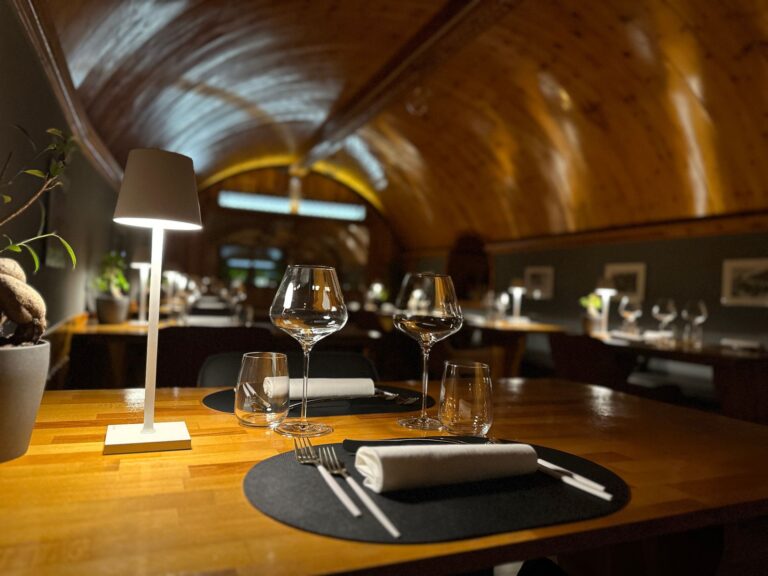
Inside, the atmosphere is soft-edged, intimate without trying too hard. The scale registers immediately. This is not a place that can be bent into banquet shape. It is a restaurant of ten tables and twenty-two covers—small enough that every table feels intentional, and calm enough that a conversation can be heard all the way to its end.
A Table for the Principals: Ristorante Gavioli in Bormio
The restaurant speaks of finezza, individuality, a Valtellinese touch. It’s a description that might sound like marketing until the first courses begin to land and you realise what they mean: refinement without fragility, technique without theatre, and flavours that are unmistakably of the north—woodland, smoke, grain, the clean fat of dairy, the gentle bitterness of herbs.
And then, before the meal has even properly begun, comes the sort of detail that quietly separates a serious kitchen from a merely ambitious one: the bread and butter. House-made, brought with the confidence of something that doesn’t need explaining. The bread arrives warm and alive, the crust offering that first satisfying crack before giving way to a tender, elastic centre. The butter is the real seduction—whipped to a silken softness, rich in the way Alpine dairy is rich, with a depth that makes you pause mid-conversation. It isn’t “a side”. It’s a statement: this is a place that takes pleasure seriously from the first bite.
You begin with a series of small, precise gestures: amuse-bouches that feel like the Alps translated into miniature form. There is salt and softness, something crisp that breaks cleanly, something warm that lingers. The pleasures are immediate, but they don’t shout. The room itself is doing some of the work, settling you, lowering the volume of the day so that you can taste properly.
Then the meal reveals its centre of gravity. Gavioli is not trying to be metropolitan. It doesn’t do that internationalised “fine dining” thing where ingredients are flown in from everywhere and the only local marker is the postcode. Here, the cooking reads like a conversation with place—Valtellina, the high valley and its habits, the animal world, the forest floor—filtered through a quiet discipline that aims for polish rather than performance.
A dish of venison, for instance, can be made clumsy in less careful hands, all iron and bravado. Here it arrives smoked and handled with restraint, its gamey sweetness made more articulate by dairy and nuts: ricotta that feels like an alpine whisper, hazelnut that adds warmth and texture, smoke that doesn’t overwhelm but lingers, like the memory of a fire you passed in the street on the way in. It tastes like winter without becoming sentimental.
What you begin to notice, as the evening gathers itself, is how the kitchen uses intensity intelligently. Mountain food can lean heavy—cream, butter, braises, thick comfort. Gavioli is interested in the mountain flavours, yes, but it is even more interested in how to lift them into something lighter on the palate. Sauces are tightened rather than thickened. Fat is balanced with acidity so that you can keep going. Bitterness appears as an accent, not a punishment. It is the sort of cooking that makes you feel looked after rather than tested.
When pasta arrives—and in Italy, pasta is always a moment—you understand the restaurant’s confidence. Buckwheat tagliolini carries the valley’s DNA in the grain itself: darker, nuttier, a subtle reminder that this is a region where buckwheat has long been part of daily life. It comes with ragù that feels genuinely considered, the wildness of game giving the dish a woodland edge, while the pasta remains the protagonist rather than disappearing beneath sauce. It’s the sort of plate that makes you pause, then take a second forkful before you’ve even properly swallowed the first.
If there is a signature to the experience, it is that nothing is used as a password. Truffle appears, when it appears, not as jewellery but as aroma and persuasion: something you smell before you taste and then chase as the flavour unfolds. Luxury ingredients are not deployed to impress but to deepen, to make a dish feel inevitable rather than expensive.
The meat course arrives with the calm decisiveness you want at this point in an Alpine dinner: something with weight, but no heaviness. Dry-aged wagyu, for example, with fresh black truffle—clean, confident, treated with enough restraint that you taste the beef first, then the ageing, then the perfume that truffle leaves in the air. There’s no need for drama when the raw materials and the technique are this sure-footed.
And then come the desserts—esquisite, in the Italian sense: exquisite, yes, but also precise, refined, considered. They arrive like small works of art, composed with the eye of someone who understands that the final impression should be as calm and confident as the first. In a mountain town it would be easy to end on rustic sweetness—cream, comfort, a kind of edible hug. Here, the close feels more sculpted: a pre-dessert that clears the palate like fresh snowfall, then a finale that satisfies without collapsing into sugar. You leave the table feeling not “stuffed” but completed, as if the meal has said what it needed to say and then, with excellent manners, stepped aside.
Throughout, service moves with the rare quality that defines true luxury: it is present without being performative. The best evenings in restaurants like this are often guided by a duet on the floor—two exceptional waiters working as one. One holds the room: greeting, pacing, reading the table’s mood, knowing when to explain and when to vanish. The other keeps the mechanics invisible: plates arriving together, glasses refilled without interruption, the entire rhythm maintained so smoothly you almost forget it is being managed. It is not “service” so much as stewardship.
If you are the sort of traveller who spends too much of life in hotels, you recognise what that stewardship does. It lowers your guard. It slows your breathing. It allows the meal to become what a meal can be: not merely sustenance, but restoration.
It’s impossible, sitting in a room like this, not to think about the modern Italian idea of luxury—how different it is from the Anglo-American obsession with spectacle. Italian refinement is often warmer, more human, more quietly exacting. That sensibility has been shaped, in part, by women who have defined fine dining as something generous rather than showy: Nadia Santini and her quiet perfection, Cristina Bowerman and her contemporary confidence, Antonia Klugmann and her intellectual approach to territory. Different voices, all evidence that you do not have to turn a meal into a performance to make it memorable. You make it memorable by getting everything right and making it feel alive.
Which brings us back to the corporate question: could Ristorante Gavioli be a venue for an intimate dinner for twenty-five executives?
Not in the obvious sense. The room is too small, the atmosphere too carefully protected. But that refusal—to become a group venue, to become a function space—is exactly what makes it valuable. Because the best executive dinners are not the ones where you manage to seat everyone at once. They are the ones where you seat the right people, at the right table, on the right night, in a room that allows trust to form without forcing it.
What makes Gavioli so useful for luxury events in Bormio is precisely that it refuses to behave like an events space. For a C-suite roundtable or discreet client evening, it offers something rarer than a private room: a room that stays quiet, by design. The most elegant way to programme it is as an anchor moment within a wider itinerary—perhaps after a day that begins with strategy and ends with recovery, a spa hour to loosen the shoulders and the mind, a short walk through the old town, then dinner where the conversation finally deepens. Host an inner-circle table for the principals, with the broader delegation entertained elsewhere at an equally polished address, and bring everyone back together afterwards for digestivi. Or, if the brief demands that all 25 share the experience, split the group across two consecutive nights and let the kitchen deliver the same calm confidence twice, rather than dilute it once.
In practice, the most elegant way to use a place like Gavioli is to treat it as an anchor, not a container. Host the principals here—client leadership, senior decision-makers, the people whose conversation actually moves the needle—and design the wider group’s evening elsewhere with equal care. Or split the group across two nights and let the restaurant do what it does best twice, rather than forcing it to become something it is not.
You step back out into the cold afterwards and the town feels even quieter, as if the streets are making room for your thoughts. There are restaurants you leave talking about décor, celebrity chefs, the fact you managed to get a table. You leave Gavioli thinking about flavour—smoke, buckwheat, the deep sweetness of game, truffle in the air—and, almost without noticing, about the conversation you had while you were tasting it.
Which is perhaps the most Italian luxury of all: a meal that doesn’t interrupt your life, but improves it.
For event enquiries and bespoke programme design, contact info@thedmccollective.com.

Related Articles

Nirup Island: Indonesia’s Exclusive Destination for Luxury Corporate Events
Nirup Island, nestled within Indonesia’s serene Riau Archipelago, stands out as a sophisticated choice for intimate luxury events, including board meetings, incentives, and exclusive partner seminars tailored for multinational audiences.
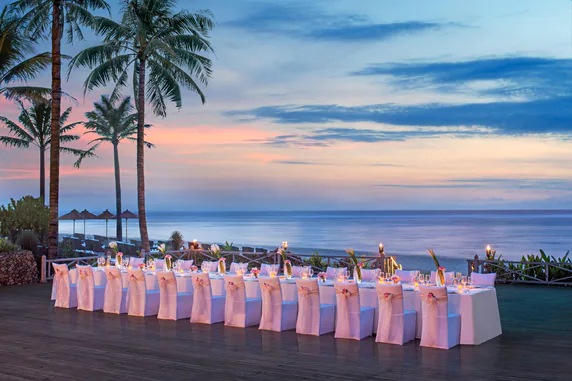
Why is Bali a Leading Destination for Corporate Event Spaces, and What Has Made Its Resorts Renowned Worldwide?
Discover why Bali is a top choice for corporate events, with world-class resorts and stunning venues that attract businesses from around the globe.
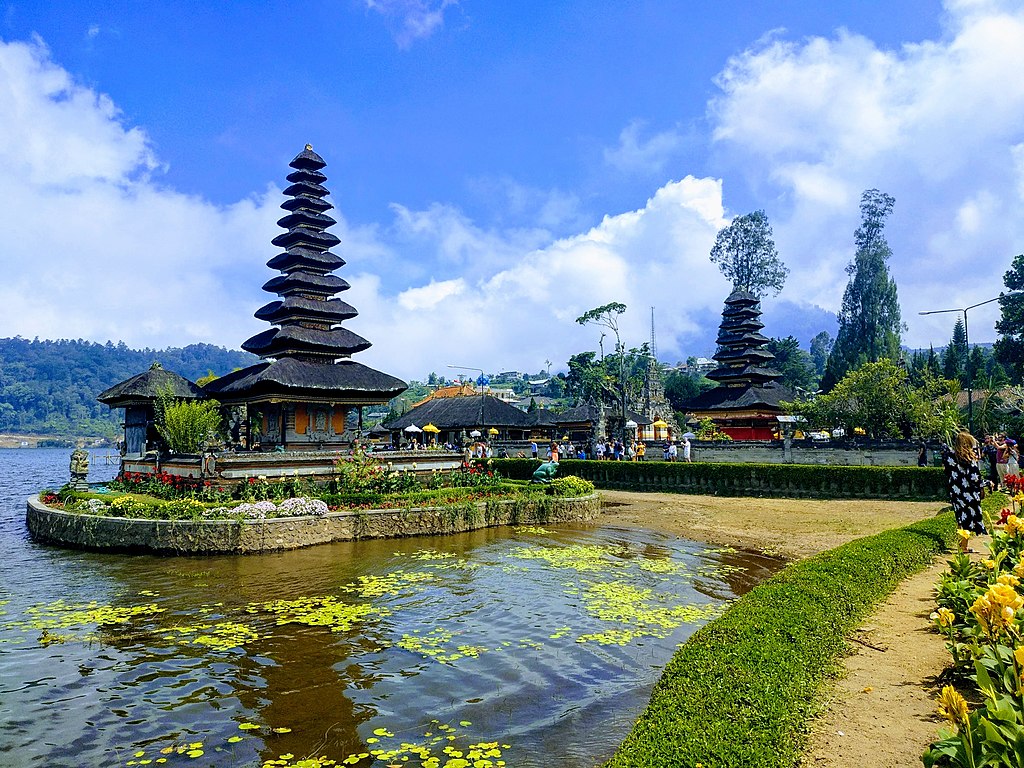
Corporate Incentive Travel Services in Bali: Why Bali Remains a Top Choice for Incentive Travel Planners
This article explores why Bali remains a top choice for incentive travel planners and highlights some of Indonesia’s hidden gems that deserve a spot on the radar of forward-thinking planners.