
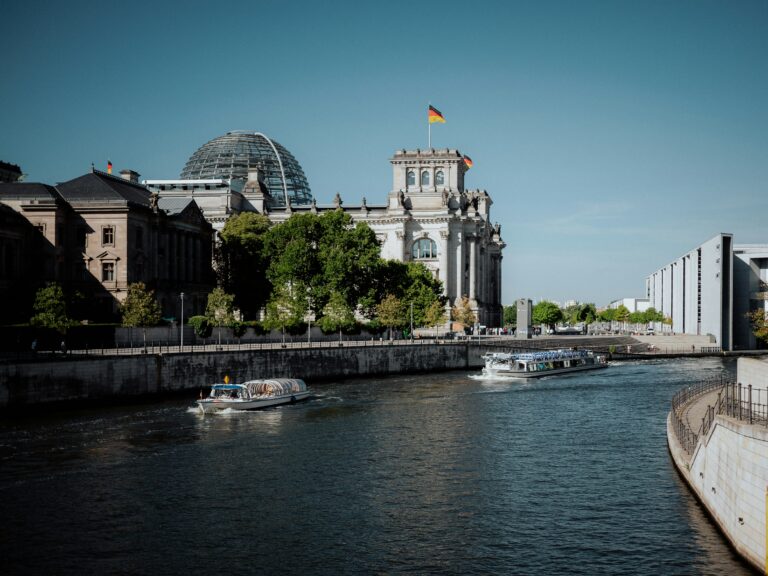
BERLIN, UNFINISHED
Why Europe’s Most Restless City Has Become Its Most Compelling Stage for Product Launches
At first light, Berlin feels suspended between yesterday and tomorrow. Dawn moves slowly across the Spree, turning the water a muted copper as an S-Bahn train hums over the tracks, slicing through the last veil of morning mist. In a vast industrial hall in Friedrichshain, a production crew unlocks the doors and begins its quiet routine: switches clicked, screens waking, light travelling across raw concrete. A draped form sits in the centre of the room. It might be a car, a medical innovation, a couture piece or a breakthrough in consumer technology. Whatever it is, the moment feels right. Berlin understands the language of beginnings.
Outside, the city stretches awake in its usual understated way — cyclists slipping through railway arches painted in decades of graffiti, the first espresso machines hissing softly, cranes shifting above old industrial yards being transformed into studios and creative workplaces. Berlin does not rush into the day. It simply becomes. And that process of becoming — steady, unselfconscious, always evolving — is exactly what gives the city its magnetism.
Increasingly, Berlin has become one of Europe’s most compelling destinations for product launches, brand reveals and innovation-driven events. Its appeal does not lie in polished perfection. It lies in honesty, in raw beauty, in its contradictions, and in the steady cultural pulse that runs beneath its surface. Berlin is never finished — and that makes it the perfect stage for what comes next.
A City in Constant Transformation
Berlin’s history is not a backdrop but a defining force. Its identity has been shaped and reshaped so many times that reinvention has become part of its civic DNA.
In the late 19th and early 20th centuries, Berlin stood as the ambitious, outward-facing capital of a growing European power. The Weimar era brought an explosion of creativity: Bauhaus ideas, modernist architecture, groundbreaking film, dance and theatre. The city was bold, inquisitive, experimental.
Then came a descent into totalitarian rule, when cultural institutions were weaponised and dissent suppressed. By 1945, Berlin lay in ruins — streets torn open, buildings shattered, neighbourhoods displaced. Few cities have had to confront destruction at such scale.
Reconstruction did not bring unity. In 1961, the Berlin Wall rose and created two distinct worlds: West Berlin, a politically symbolic enclave sustained by subsidies and cultural stubbornness; and East Berlin, where ideology shaped public life but creativity persisted in quiet, intelligent, often coded forms.
When the Wall fell in 1989, the city inhaled sharply. What followed was one of the most remarkable periods of urban reinvention in modern Europe. Empty factories became clubs, power stations became cultural centres, railway depots turned into galleries, and the world’s creatives arrived in a wave.
Berlin became known as “poor but sexy”, an unvarnished city that welcomed experimentation and valued cultural life over surface shine. That phrase feels dated today — Berlin is wealthier, more organised, more professional — but the spirit remains. This is still a city where reinvention is not a slogan but a lived experience.
For brands, this matters.
A launch is not about what is.
It is about what might be.
And Berlin’s identity — never quite complete, never fully resolved — gives space for big ideas to breathe.
A Creative Capital With Cultural Depth
Berlin’s creativity is not a marketing veneer. It sits at the heart of daily life. As a UNESCO City of Design, it houses a vast network of designers, architects, digital artists and makers. More than 40,000 creative companies operate here, alongside hundreds of galleries, art institutions and cultural collectives.
Yet Berlin’s creative strength is not confined to what happens in studios or museums. It lives just as vividly in street art that climbs ten storeys high, in local markets, in the architecture of repurposed industrial buildings, and in the steady evolution of its food, fashion and design scenes.
The city is also shaped by music culture. Techno — recently recognised as part of Germany’s intangible cultural heritage — continues to influence visual design, production values and the sensory architecture of events. In Berlin, light and sound are not decorations. They are tools for communication.
For brands seeking authenticity and cultural relevance, Berlin offers something rare: a living creative ecosystem that welcomes innovation rather than simply accommodating it.
A City Built for Layered Experiences
Berlin’s geography lends itself to storytelling. Rather than a rigid grid or grand procession of boulevards, it unfolds as a series of distinct neighbourhoods, each with its own atmosphere and architectural language. This makes multi-stage launch events not only possible, but natural.
A morning might begin in Mitte or near the Brandenburg Gate, where modernist venues such as AXICA, Futurium, or the Berlin Congress Center provide clarity and elegance. These spaces, defined by clean lines and calm geometry, are ideal for strategy, narrative framing and the formal unveiling of a product.
From there, a launch can shift — easily, within minutes — to Kreuzberg, Neukölln or Friedrichshain. Here, the industrial legacy of Berlin comes alive: former factories with cathedral-like ceilings, machine halls with exposed steel, power stations turned cultural landmarks. These are places where immersive storytelling thrives, where technology demos feel more powerful, where fashion becomes performance and automotive reveals become cinematic.
By evening, the narrative can move again. Rooftop terraces along the Spree offer soft light and city views. Old warehouses glow with warm amber bulbs. Spaces with club-like acoustics shift into celebration mode. Guests relax, conversations deepen, and the emotional tone of the day settles into memory.
This fluidity is uniquely Berlin. The city invites movement — not only physically, but emotionally — and that dynamic supports launch journeys with multiple moods and chapters.
Venues That Shape Emotion
Berlin’s event venues carry a depth of character rarely found elsewhere in Europe. They can be grouped into a few distinct archetypes:
Industrial Cathedrals – the icons of post-Wall Berlin.
These vast, raw spaces — once power stations, factories or railway works — lend weight and atmosphere to a launch. They are ideal for mobility brands, fashion, performance technology or any product with sculptural presence.
High-Tech Studios – the city’s digital evolution.
Spaces such as Backfabrik or hybrid studios built for film, streaming and XR allow brands to create multi-layered, broadcast-ready experiences. These are perfect for technology, medtech and software-driven launches.
Modernist Canvases – refined, understated, intelligent.
Futurium, bcc and AXICA each offer contemporary architecture with a focus on clarity and precision. Medtech, luxury tech, sustainability and design-led products perform exceptionally well in these environments.
Historic Venues – elegant, atmospheric, grounded.
Charlottenburg’s heritage spaces, museums and theatres offer a tone of cultural gravitas without imposing formality.
What unites all of these is Berlin’s signature directness. The spaces do not shout. They do not show off. They offer structure, depth and atmosphere — letting the product take centre stage.
A European Hub for Mobility and Innovation
For automotive, mobility and engineering brands, Berlin offers something few cities can match: a living laboratory for the future of movement.
IFA Berlin provides a global platform for electric vehicles, charging infrastructure, e-bikes and mobility technology. CWIEME Berlin gathers the engineering world behind electric motors, the core technology driving the EV transition. Meanwhile, countless start-ups test new models: remote-operated vehicles, autonomous logistics, shared mobility systems, digital traffic coordination and sustainable transport solutions.
And then there is Tempelhof — a former airport turned urban landscape, with runways that stretch openly across the horizon. It is a remarkable space for EV test tracks, drone shows, large-scale demos or cinematic shoots. Few places in Europe combine history, scale and atmosphere so effectively.
Berlin is not only a stage for mobility launches. It is part of the narrative.
Immersion as a Cultural Strength
Berlin does not approach immersion as spectacle. Instead, it uses sound, light, texture and atmosphere with discipline and intention. This comes from its cultural history — from theatre, from techno, from post-industrial creativity, and from a population accustomed to experimental environments.
For event designers, this means the city offers a shared language: lighting that shapes emotional pacing, sound that creates spatial depth, minimalism that allows products to breathe, and spatial compositions that encourage intuitive flow.
Immersion in Berlin feels natural. It feels considered. And it allows brands to build storytelling that is memorable without becoming overwhelming.
A Human City at Heart
Berlin’s hospitality is not flamboyant. It is steady, sincere and quietly attentive. Service is delivered with clarity rather than ceremony. Berliners value substance over performance, which often leads to experiences that feel authentic and comfortable.
The city’s culinary culture mirrors its personality: modern, international and quietly imaginative. Michelin-starred restaurants sit alongside Turkish grills, vegan pioneers, local wine bars, neighbourhood bakeries and riverside dining spaces ideal for press events or intimate brand dinners.
The hotel landscape is similarly diverse, offering design-driven boutique properties, luxury suites with refined German restraint, and contemporary business hotels that are efficient without feeling impersonal.
Guests leave Berlin with a sense of having encountered something real — something grounded in culture rather than staging.
Infrastructure That Works Without Fuss
Behind Berlin’s cultural energy lies a reliable event infrastructure. BER Airport offers smooth international connectivity. The public transport network is fast, clean and intuitive. Districts are connected in ways that make multi-venue events realistic. AV teams, production houses and technical suppliers are experienced, capable and accustomed to working across creative industries.
The Berlin Convention Office provides support for sustainable event planning, venue sourcing and logistics — a valuable complement for planners designing complex, multi-stage launches.
Berlin makes ambitious events not only inspiring but workable.
The Power of the Unfinished
When the final reveal ends and guests step into the Berlin night, the city holds a particular stillness. The river reflects the lights of old warehouses now transformed into cultural spaces. Music drifts lightly from a distance. Berlin does not feel like a city resting. It feels like a city in transition, already imagining tomorrow.
This is the essence of Berlin’s appeal.
It is not polished into perfection.
It does not pretend to be complete.
It does not hide its layers.
It embraces change — directly, honestly, intelligently.
For brands unveiling something new, there is no stronger narrative partner.
A product launch in Berlin becomes part of a larger story: one of transformation, resilience, creativity and continual evolution.
Berlin doesn’t just host your launch.
It elevates it.
It sharpens it.
It makes it memorable.
It offers a future-facing stage for ideas that deserve to be seen — and a city that understands, perhaps better than any other, that becoming is more interesting than being.
Let’s craft something extraordinary together.
Discover Berlin with The DMC Collective
To explore how Berlin can elevate your next product launch or corporate event, contact:
📧 info@thedmccollective.com
Let’s create something extraordinary together.

Related Articles

Nirup Island: Indonesia’s Exclusive Destination for Luxury Corporate Events
Nirup Island, nestled within Indonesia’s serene Riau Archipelago, stands out as a sophisticated choice for intimate luxury events, including board meetings, incentives, and exclusive partner seminars tailored for multinational audiences.
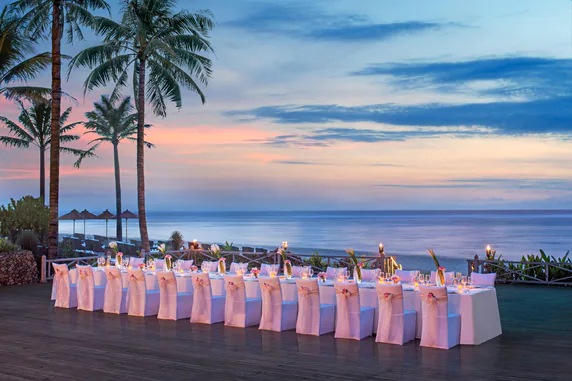
Why is Bali a Leading Destination for Corporate Event Spaces, and What Has Made Its Resorts Renowned Worldwide?
Discover why Bali is a top choice for corporate events, with world-class resorts and stunning venues that attract businesses from around the globe.
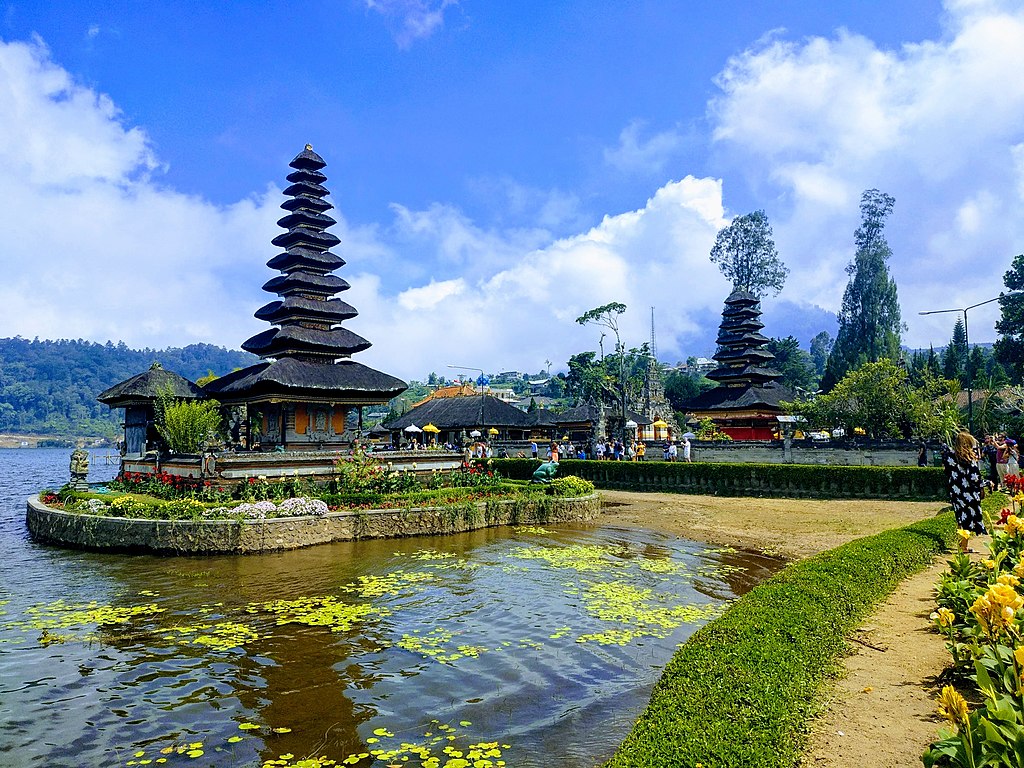
Corporate Incentive Travel Services in Bali: Why Bali Remains a Top Choice for Incentive Travel Planners
This article explores why Bali remains a top choice for incentive travel planners and highlights some of Indonesia’s hidden gems that deserve a spot on the radar of forward-thinking planners.