
Corporate Glamping Bavaria: From Festival Field to Forest Lodge | The DMC Collective
How the Glamping Generation is Reshaping the Corporate Incentive
A generation of employees who learnt everything about trust, hierarchy and human connection in a Somerset field is now sitting in your workforce. They are not impressed by the airport Marriott. Here is what they want — and where, in the forests and Alpine valleys of Bavaria, you can give it to them.
It is three in the morning at a music festival somewhere in the west of England. The last band finished two hours ago. A group of people who did not know each other forty-eight hours earlier are sitting around a fire that nobody planned to keep going this late, talking about things they would never discuss in daylight. Someone has made tea in a billycan. The sky is doing something extraordinary. By the time they walk back to their tents, something between them has changed permanently.
They do not know it yet, but this is the most important team-building exercise they will ever experience. Nobody scheduled it. Nobody facilitated it. Nobody wrote learning objectives for it on a flip chart. The fire did the work. The landscape did the work. The deliberate absence of an agenda did the work.
Then they graduated. They got jobs. They were handed a glossy brochure for a three-night leadership conference at an airport hotel with a spa and a golf course and a gala dinner on the final evening, and something in them went very quiet.
That quiet is now one of the most expensive problems in European business. And Bavaria — its forests, its Alpine lodges, its lake valleys — is where some of the most forward-thinking companies in the world are beginning to solve it.
The Workforce Has Changed. The Incentive Hasn't.
“More than half of younger employees will decline incentive trips that do not align with their values.” — IRF & SITE Foundation, Incentive Travel Index 2025
By 2025, Millennials and Gen Z together account for nearly 60 per cent of the European workforce, according to research from Deloitte and the World Economic Forum. These are not simply younger workers. They are a generation defined by a particular kind of education — one that took place in fields rather than classrooms, around fires rather than projector screens, in conditions that stripped away the usual social scaffolding and made connection happen faster than any workshop could engineer.
The Incentive Research Foundation’s 2025 Incentive Travel Index — the most authoritative study of its kind, produced with Oxford Economics — found that more than half of these employees will decline incentive trips that do not align with their values. Two-thirds of industry professionals believe this cohort will force a fundamental retooling of how corporate reward travel is designed. Spending on incentive travel is projected to increase by 54 per cent in 2025 alone, with 81 per cent of organisations now regarding it as essential for retaining top talent. The stakes are not soft. They are on the CFO’s spreadsheet.
There is a further dimension, and it matters to the organisations thinking seriously about this. European companies are leading the world on sustainable incentive travel — a third of European buyers now cite it as a long-run priority, more than double the North American figure. When employees spend three days sleeping in a forest, eating food grown nearby and moving through a landscape they can see and smell and touch, they return with a different relationship to the company’s environmental commitments. Values performed in a presentation are values. Values experienced in an old-growth forest become something closer to belief.
The retooling of the corporate incentive, when you strip back all the industry language around it, looks rather a lot like a festival. With better beds and a private chef. And increasingly, it is happening in Bavaria.
Thinking about your next incentive programme in Bavaria?
Our local team is available for an initial conversation at no cost — no pitch, no pressure. Tell us your group size, your ambitions and your timeline.
From Festival Design to Corporate Retreat Design
The most powerful thing a festival does is remove hierarchy. In a field, or a forest, or around a campfire, your job title becomes temporarily irrelevant. The CEO and the newest graduate are equally subject to the weather, equally dependent on the communal cook, equally likely to find themselves in a conversation they were not expecting and will not forget. Rank dissolves. What remains is character. And from character, something that no team-building workshop has ever reliably produced: genuine trust.
Festival designers have understood this architecture for decades. The best corporate retreat designers are now borrowing from the same blueprint. The elements translate directly. Residential formats — where guests sleep on site, in lodges or chalets rather than being bussed back to a city hotel — mean that conversations which begin over dinner have somewhere to go instead of ending at the taxi rank. Campfire moments, some planned and most not, are the social crucibles where real bonds form: not in facilitated exercises but in the unguarded hour after midnight when the professional masks have quietly come off. Natural materials and sensory richness — wood, stone, pine resin, the cold air of an Alpine morning — prime the mind for openness in ways that a carpeted conference suite actively prevents. And white space in the agenda, genuine unscheduled time where people are trusted to rest or roam as they choose, communicates something that no employee handbook can: that the organisation trusts its people.
We build our retreat programmes around a practice the Japanese call shinrin-yoku — forest bathing, the act of being deliberately, unhurriedly present in a landscape of trees. The science behind it is serious and measurable: cortisol drops, heart rate slows, blood pressure falls, often within twenty minutes. We use it not as a wellness add-on but as the first act of every programme — the essential transition from office mode to human mode that has to happen before any strategic work can mean anything. Everything else flows from the quality of that first hour in the trees.
The IRF confirms what every festival veteran already knows: 89 per cent of incentive travel participants regard genuine downtime — unhurried time in a beautiful place — as the single most important element of a successful programme. The festival generation did not need a foundation to tell them this. They discovered it at three in the morning in a field in Somerset, watching the sky turn pale. What they want now is the same quality of experience, designed with the care and comfort that their working lives have earned.
Why Bavaria — and Three Properties That Do This Beautifully
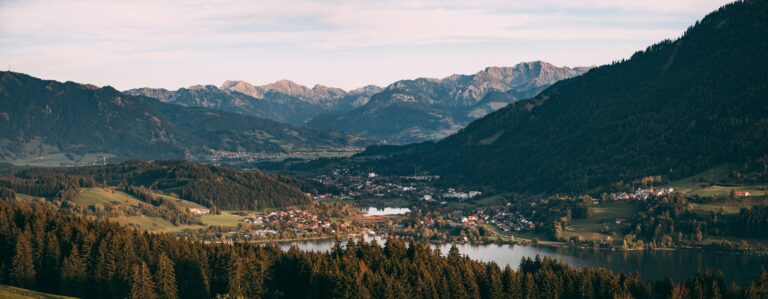
Stand at the edge of the Tegernsee on a September morning and the case for Bavaria makes itself. The lake is a deep, cold green — glacial meltwater held in a valley the Ice Age carved. Behind it, the limestone ridges of the Alps rise in a single unbroken line, already dusted with the first snow of autumn. The air smells of pine resin and cold water. There is no urban noise. The nearest sound is a cowbell, somewhere above the treeline.
Drive west and the landscape opens into the Allgäu: wide valleys, hilltop churches, meadows still thick with wildflowers into October, that particular soft Alpine light that painters have been coming to find for two centuries. Drive east and you enter the Bayerischer Wald — old-growth forest, the largest in central Europe, where silver firs grow to forty metres and the forest floor holds a year-round green that no season disrupts. In winter the tree canopies hold snow like cupped hands. In summer the light filters down in shafts that make a simple walk feel like something more.
Bavaria sits at the centre of Europe. From Zurich, a direct EuroCity train runs every two hours — and for groups heading to the Allgäu, the train passes through the region itself, so the journey through meadows and approaching Alps is the first act of the experience. By car from Zurich, it is under three hours along the northern shore of Lake Constance. From Innsbruck, barely ninety minutes north. Munich Airport connects to every major European hub, with transfers directly to any property we recommend. The journey to Bavaria, however your group travels, can be the beginning of something — not just the means of arrival.
Across the region, three properties stand out. Each occupies a different point on the scale. All three understand, in their different ways, exactly what this kind of experience requires.
FORSTGUT · BAYERISCHER WALD · FOR GROUPS OF 20–26
You smell the pine before you see the chalets. Thirteen of them, scattered through old-growth forest, each one invisible from the next — no reception desk, no conference signage, no lobby hum. Just timber and silence and, through a glass door at the back, your own hot tub sitting in the trees with steam rising off the water at dusk. The wood-burning fireplace is already laid when you arrive. The fridge is stocked with things from farms within twenty kilometres. The river you can hear but not quite see from the terrace is the Schlossauer Ohe, and it has been making that sound for considerably longer than any company in your industry. By the second morning, the office exists in theory only.
DAS TALGUT · OBERALLGÄU · FOR GROUPS UP TO 20
The mountains arrive before the lodge does — filling the windscreen as you come over the last rise into the Allgäu, closer and more immediate than you expected. Das Talgut sits at the edge of a golf course outside Ofterschwang, eight individually designed lodges in a landscape so deliberately beautiful it feels almost unfair. Inside: the smell of cedar from the sauna, handmade linen on the beds, a terrace facing west where the evening light turns the peaks amber and rose and then, slowly, dark. Breakfast is delivered to your door in a wooden basket — local cheeses, dark rye, a small jar of something from a nearby farm. In winter, the ski lift is five minutes on foot. In any season, the sense that you are exactly where you are supposed to be arrives within hours of getting there.
BACHMAIR WEISSACH GROUP · LAKE TEGERNSEE · FOR GROUPS OF 12–300
Lake Tegernsee on a clear morning is the kind of thing people move to Bavaria for: the water an impossible Alpine green, the mountains reflected perfectly in it, the far shore close enough to feel intimate but far enough to feel like wilderness. The Bachmair Weissach Group has eight venues arranged around it — from the flagship spa resort with 130 rooms and conference spaces for up to 300, to Wildbad Kreuth, a private forest lodge up the valley for closed-door leadership sessions, to the Berghotel Altes Wallberghaus at 1,512 metres, where you have dinner above the clouds and the cable car back down feels like re-entering the world. We are the Group’s chosen events partner, which means access to dates and configurations that do not appear on any public booking system. You tell us what you need. We open the doors.
Ready to see the Bachmair Weissach Group in person?
We can arrange a virtual tour or site visit across any of the eight venues at Lake Tegernsee — at no cost to you.
Three Days in the Forest — What It Actually Looks Like
Theory is necessary. But an itinerary is more honest. Here is how we build a three-night corporate retreat at Forstgut for a group of twenty senior managers — and why each element has been chosen with care rather than convenience.
DAY ONE — ARRIVE, UNPLUG, RESET
Most groups arrive after a full working day — laptops still warm, phones still buzzing, three back-to-back calls still echoing. The first job is not welcome drinks. It is decompression. The coach from Munich Airport stops in the National Park for a short walk before the property. No commentary. No objectives. Just twenty minutes among trees that are older than the company, with a guide who walks slowly and does not rush anyone. By the time the chalets come into view through the pines, something has already shifted.
On arrival: no group briefing, no agenda on the wall, no name badges. Just the keys, the fire already lit, and a hamper inside each chalet — cheese from a nearby farm, dark Bavarian bread, a bottle of something cold. People change out of their work clothes. Someone finds the hot tub. Someone else discovers the wood stack and decides the fire needs building up. Within an hour, the suits are gone — literally and otherwise.
Dinner is the evening’s centrepiece: a whole-animal feast outdoors, prepared over fire by a chef from the nearest village, with the smell of woodsmoke and slow-cooked meat drifting through the clearing. There is local beer. There is music — a guitarist we bring in, or someone in the group who produces an instrument, as someone always does. The conversation moves the way it only moves when people are warm and fed and outside in the dark: slowly, honestly, without agenda. Nobody goes to bed before midnight. Nobody wants to.
DAY TWO — THE CORE
Guided breathwork at dawn in the clearing — fifteen minutes, for those who choose it. Nothing more demanding than paying attention to your own breath in cold morning air. It is, consistently, the session our participants mention most often when they come back to us months later. Breakfast at a long communal table set outside. Then a morning of facilitated strategic dialogue — not in a meeting room, but in the meadow adjacent to the property, using portable furniture and the natural amphitheatre of the tree line. Lunch is Brotzeit brought to the group in the field: Brezel, cold cuts, strong Allgäu cheese, apple juice from a local farm.
The afternoon is the group’s. We design the programme around what your team needs — and no two afternoons look the same. Some groups want competition: the Bavaria Olympics, a relay of absurd and brilliant challenges through the forest and meadows that has a way of revealing who people actually are when the professional armour comes off. Others want water: a team sailing regatta on the Tegernsee or the Chiemsee, where reading the wind together and nearly capsizing together turns out to be extraordinarily good for working relationships. Some groups want the mountain: a guided ridge walk with the Allgäu spread below, the kind of effort that earns the evening. And some individuals need exactly what the afternoon offers without any programme at all — a solo hour in the sauna, a kayak on the river, a book on the terrace with the forest on three sides. We plan for all of it. Nobody is required to do anything. That is, in itself, part of the point.
Dinner is at a local Gasthof ten minutes by minibus: low ceilings, candles in wine bottles, Sauerbraten and Knödel, the kind of warmth that cannot be staged because it has been there for a century. The conversations that began in the morning’s facilitated session continue here without any of its formality. Nobody is taking notes. Everyone is paying attention.
DAY THREE — RETURN
A final walk through the National Park, led by the same guide who met the group on day one — so that arrival and departure are held in the same unhurried attention. Then the closing circle around the firepit. The same fire. The same clearing. Ten minutes. No presentations. Each person says one thing they are taking back.
The coach departs with a packed lunch from the chef. The group arrives back in their home cities not depleted but genuinely restored — and more invested in each other and in the organisation than they were seventy-two hours earlier. The budget for this programme sits between €850 and €1,500 per person per day, inclusive of everything. Set against the cost of staff turnover — which the Society for Human Resource Management estimates at between 50 and 200 per cent of annual salary — it is arguably the highest-return investment a company can make in its people.
Want us to build this programme for your group?
Share your group profile, your dates and your objectives. We will come back with a bespoke itinerary — no cost, no obligation.
The Fire Is Still Burning
The festival generation is not asking for anything unreasonable. It is asking for the conditions that allow human beings to function at their best: beauty, informality, genuine rest, and the particular quality of conversation that only happens when the agenda has been left behind. These are not luxuries. They are, according to every serious study the incentive travel industry has produced in the last five years, the foundations of the retention, loyalty and team cohesion that organisations are spending enormous amounts of money trying to produce by other means.
Bavaria has been providing these conditions for a long time. The forest was there before the conference centre. The Hütte was there before the hotel. The fire was there long before the slide deck. What has changed is simply that the corporate world has begun to understand what the people sitting around that fire already knew: that the best things — the conversations that matter, the connections that hold, the ideas that arrive without being summoned — do not happen in rooms. They happen in places.
Your Questions, Answered
Five questions we hear from event planners considering this kind of programme for the first time.
Is a glamping-style retreat suitable for larger groups?
Yes, and the format adapts with the scale. For groups up to 30, the fully residential compound model — where everyone sleeps, eats and moves through the same environment together — produces the deepest relational impact. For 50 to 200 people, a hybrid approach works well: boutique lodge accommodation for senior participants, combined with a nearby facility for plenary sessions. For groups of 200 to 5,000, Center Parcs Park Allgäu offers the scale of a major conference venue within a 180-hectare nature estate, with full park buyout options and DGNB Gold sustainability certification. The Bachmair Weissach Group scales from intimate sessions of 12 to conferences for 300. The philosophy is the same at any size: the environment is not the backdrop. It is the experience.
How does the cost compare to a traditional conference hotel?
The per-person daily rate for a fully managed lodge retreat — accommodation, all food and drink, activities, facilitation, guide fees and transfers included — typically sits between €850 and €1,500. This is broadly comparable to a 4- or 5-star conference hotel package in a major European city, once you factor in evening dinners and excursions. What differs is the return. A residential format, where the experience continues through the evening rather than ending at the taxi rank, generates a measurably different quality of team cohesion. And a setting that does psychological work on your group without any facilitation is not a nice-to-have. It is the most cost-efficient element of the entire programme.
What is the best time of year?
Bavaria rewards all four seasons differently. Late spring — May to June — brings wildflower meadows and long warm evenings, ideal for outdoor programming. Early autumn — September to October — offers golden forests, cooler air and a quality of light that photographers travel from across Europe to find. Summer is the most popular period; book early, as the best properties fill months in advance. Winter is the season that surprises people most. A snow-covered forest compound, a firelit chalet, a private sauna at minus eight outside, the Wallberg above the clouds — it is an experience no other season can replicate. Tell us your window and we will tell you honestly what each season offers your specific group.
Our delegates are travelling from Switzerland, Austria and across the region — how does access work?
Bavaria is one of the most accessible destinations in central Europe. From Zurich, a direct EuroCity train runs every two hours — and for groups heading to the Allgäu, the train passes directly through the region, making the journey itself part of the arrival experience. By car from Zurich, the drive along Lake Constance and into the Allgäu takes under three hours. From Innsbruck, barely ninety minutes north. Salzburg sits under two hours east of Munich by train or motorway. We coordinate group rail bookings, private coach transfers or a combination of both — depending on where your delegates are travelling from and which option makes the best arrival story for your group.
How far in advance do we need to book?
For boutique compound properties — Forstgut, Das Talgut — six to nine months ahead is the right horizon, particularly for spring and autumn dates, which go first. The Bachmair Weissach Group can often accommodate shorter lead times of three to four months, and our position as the Group’s chosen events partner gives us access to dates and configurations that are not publicly available. Come to us as early in your planning cycle as possible. We will tell you honestly what is achievable — and we will not oversell.
The retreat your team has been waiting for
Tell us about your group, your ambitions and your budget.
Our local teams across Bavaria, the Allgäu and Lake Tegernsee will take it from there.

Related Articles

Nirup Island: Indonesia’s Exclusive Destination for Luxury Corporate Events
Nirup Island, nestled within Indonesia’s serene Riau Archipelago, stands out as a sophisticated choice for intimate luxury events, including board meetings, incentives, and exclusive partner seminars tailored for multinational audiences.
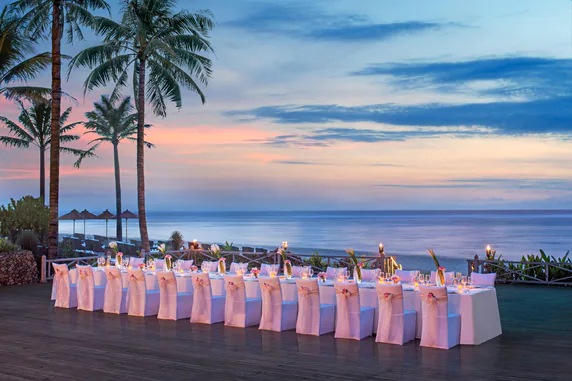
Why is Bali a Leading Destination for Corporate Event Spaces, and What Has Made Its Resorts Renowned Worldwide?
Discover why Bali is a top choice for corporate events, with world-class resorts and stunning venues that attract businesses from around the globe.
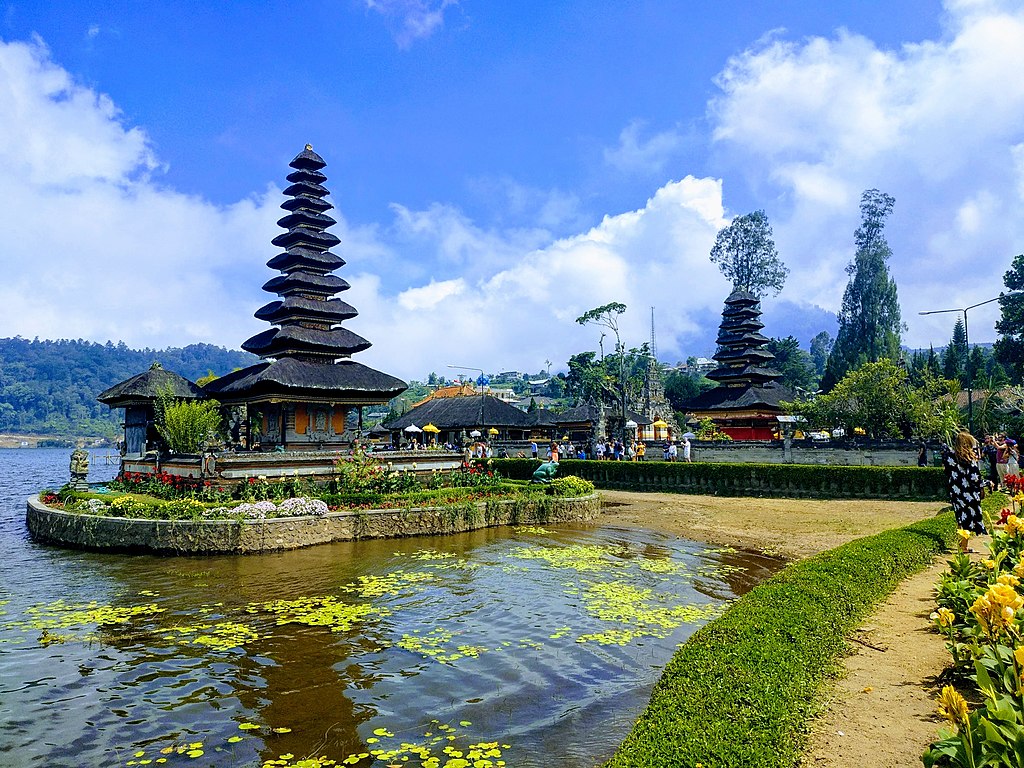
Corporate Incentive Travel Services in Bali: Why Bali Remains a Top Choice for Incentive Travel Planners
This article explores why Bali remains a top choice for incentive travel planners and highlights some of Indonesia’s hidden gems that deserve a spot on the radar of forward-thinking planners.